
This week, electronics manufacturer ESCATEC announced it had stood up in-house injection molding for BPA-free resins at its Johor Bahru plant. The interesting part isn't the claim on the bag. It's the list of work the company said the switch required: qualifying BPA-free resin suppliers, building a controlled molding process, dedicating a machine exclusively to that production, and keeping it strictly segregated from conventional resin.
That list is the real story. Swapping pellets is easy. Proving the part that comes out the other end is still the part you qualified is not.
The leftover pellet is a process input
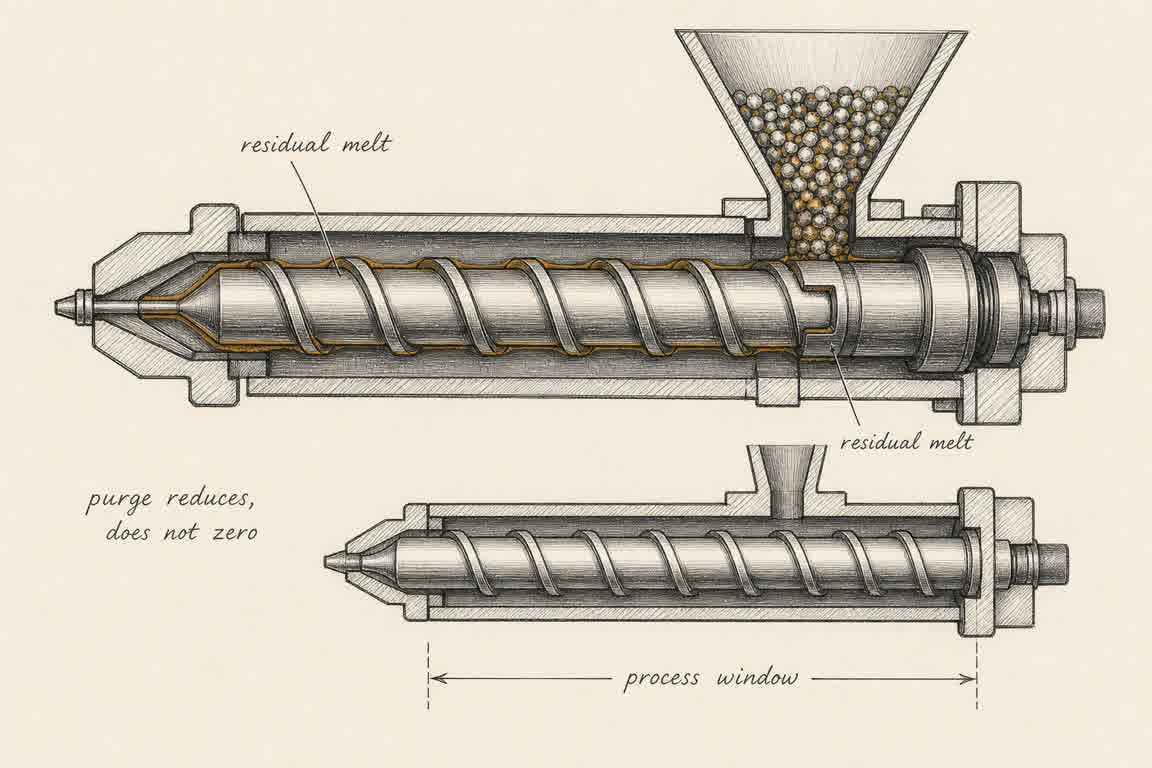
A molding press does not forget the last grade it ran. Residual pellets sit in hoppers, dryers, and feed throats. Melted residue coats screws, barrels, check rings, and hot-runner manifolds. A purge cycle reduces that load. It does not zero it.
For a BPA-free, low-extractable, or drug-contact claim, even a small carryover is the whole problem. The new grade isn't just different plastic — it's a different chemical inventory sitting in the same steel. The additives from the last lot don't disappear because the label on the bag changed.
That's why dedicated equipment shows up in a serious resin conversion. A machine used only for the new family removes the residual path entirely. Segregated dryers, dedicated hoses, labeled bins, and a locked recipe do the rest. None of it is theater. It's how the last job doesn't become an undeclared ingredient in this one.
The process window moves with the grade
Even with zero carryover, the process still isn't the same. Melt temperature, viscosity, shrinkage, drying, and cycle time are properties of the resin, not the tool. A medical-grade polypropylene that fills a luer body at one set of parameters won't fill the same cavity the same way if you drop in polycarbonate, COC, or LSR without re-establishing the window.
Shrinkage is the quiet one. A few tenths of a percent on a sealing taper is the difference between a connector that seats and one that weeps. Gate freeze, pack, and cooling all move when viscosity moves. The tool didn't change. The physics did.
So a resin conversion is a process re-qualification, not a purchasing event. The protocol that ran IQ/OQ/PQ on the original grade doesn't automatically cover the substitute. First articles on the new material have to prove the drawing still holds — dimensions, flash, weld lines, cosmetic callouts — before anyone treats the change as done.
What change control actually has to catch
On a regulated component, the resin grade is a controlled input. The certificate of conformance or analysis, the lot number, and the drying record travel with the part. Change the grade and the evidence package changes with it:
- Supplier qualification
- Incoming inspection
- Process parameters
- First-article inspection
- Biocompatibility and sterilization notes, where the device requires them
Those records feed the customer's Device Master Record. They don't live in a hallway conversation.
Second-sourcing a "same" polymer is the same job with a friendlier name. Two medical-grade polypropylenes from two different suppliers aren't interchangeable until someone has shown they process, shrink, and document the same way. ESCATEC's write-up is useful because it names the unglamorous steps in order:
- Qualify the supplier
- Lock the process
- Dedicate the machine
- Segregate the floor
Skip a step and what you have is a bag of pellets and a hope.
Put the grade on the table before the tool is cut
Material is one of the inputs on an instant CAD quote for a reason. The geometry is only half the part. Wall thickness, cavitation, cycle time, and tooling class all depend on the resin you actually intend to run — and the DFM notes that come back with the price flag those mismatches before steel is cut, not after.
We mold custom components in the engineering and medical-grade thermoplastics a single-use device actually uses, and we stock ISO 80369 connectors, caps, and clamps in known grades with the price on the page. Parts are produced under an ISO 13485 quality system, with CoC/CoA, inspection records, and lot traceability filed against the part. Sterilization validation and biocompatibility testing, where a device needs them, run through qualified partners, and those records come back with the rest.
The lesson from this week's BPA-free stand-up is the same lesson as a luer fitting in polypropylene versus polycarbonate: pick the grade on purpose, treat the conversion as a process, and don't let a hopper swap impersonate a validated change.
Get the material notes with your quote.
Upload a CAD file for an instant molding quote — wall thickness, cavitation, cycle, tooling class, and material notes for the resin you pick, before any steel is cut.
Get an instant CAD quote →